A production line is only as reliable as its smallest components. Across machine tools, packaging and assembly equipment, conveyors and automated lines, the same four failure patterns appear:
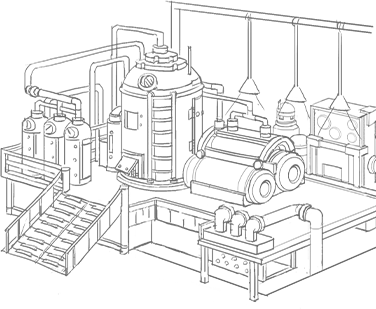
 An automated production line in operation — KACON proximity sensors, limit switches, relay terminals and tower lights handle its sensing, position switching and signal indication.
Sensing gaps. Parts presence, position, counting and speed feedback depend on sensors that must fit tight mounting spaces, survive coolant and dust, and keep up with cycle rates.
Mixed position feedback. End-of-travel and guard positions need positive, repeatable mechanical switching that a sensor alone cannot always provide — especially where the switch is part of a safety function.
Wiring labour. Dozens of relay points wired one by one between the PLC and the field cost cabinet space, assembly hours and debugging time.
Invisible machine status. Operators supervising several machines need line status — running, warning, stopped, fault — readable at a glance from across the floor.
Sourcing these four functions from one industrial-control family simplifies specification, spares and support. KACON's automation solution combines its KPR proximity sensors, five limit switch series, relay and PLC terminal modules, and tower lights into a single component set for equipment builders and panel builders.
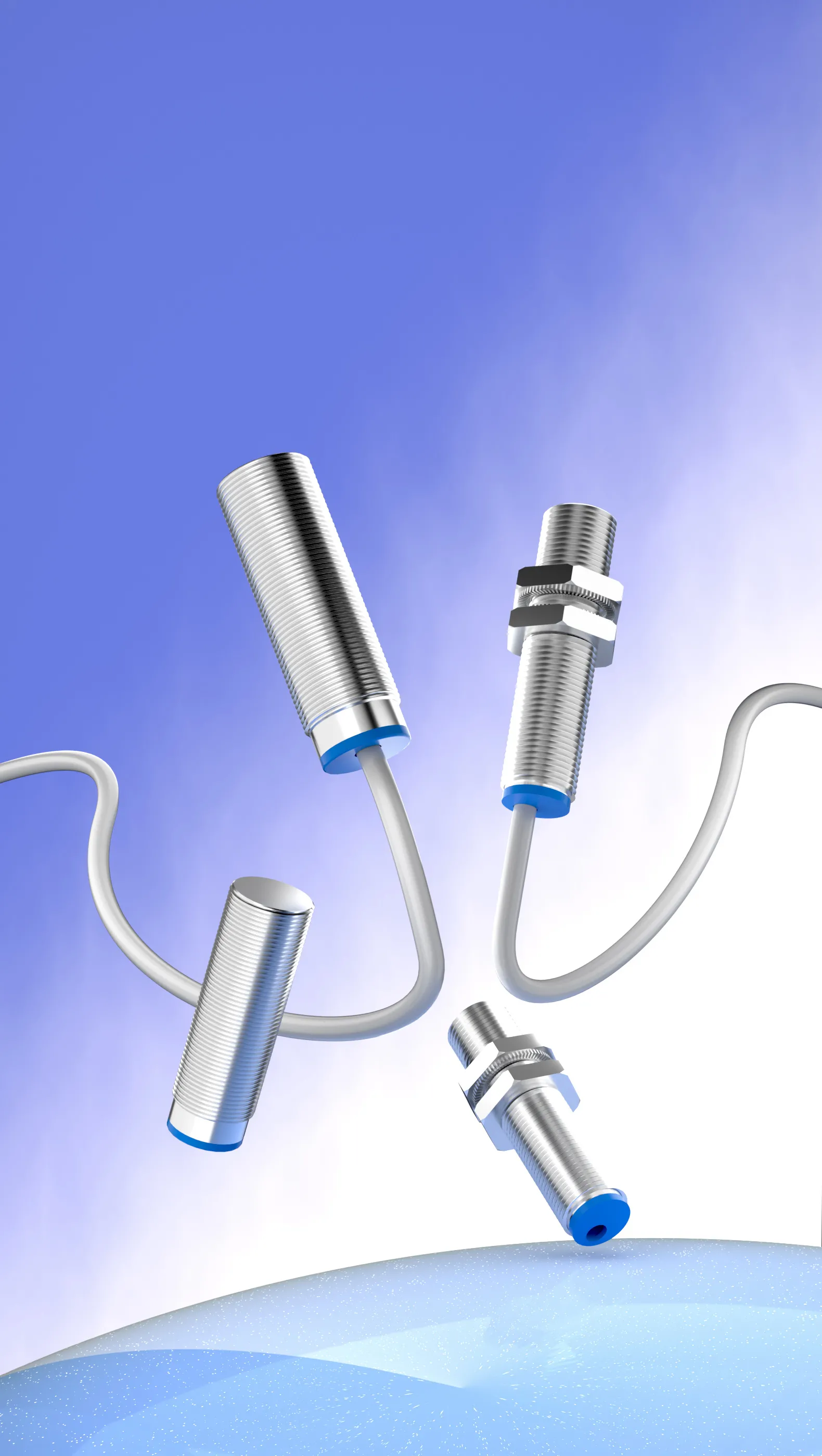
The KPR Series inductive proximity sensor covers metal detection from the tightest flush-mount pockets to long-range positions, all sealed to IP67 with reverse-polarity, overload and short-circuit protection:
 KACON KPR Series inductive proximity sensors
| Housing | Mounting | Sensing distance (steel) | Response frequency |
|---|---|---|---|
| Ø3 / Ø4 / M4 / M5 | Flush | 0.6–1.5mm | Up to 2000Hz |
| M8 | Flush / non-flush | 1–6mm | 500–2000Hz |
| M12 | Flush / non-flush | 2–10mm | 150–2000Hz |
| M18 | Flush / non-flush | 5–20mm | 100–1000Hz |
| M30 | Flush / non-flush | 10–40mm | 100–300Hz |
Outputs are DC 3-wire NPN or PNP (NO/NC) on 10–30V DC, with 2-wire versions for simple loops, standard/short/ultra-short bodies, and 2m cable or M8/M12 connector connections — so the same series handles high-speed counting on a packaging machine and presence detection on a conveyor. Browse the full proximity sensor range for model selection.
Where a position must be confirmed mechanically, the KACON limit switch range offers five series by duty:
 KACON KXL Series limit switch
| Series | Type | Key rating | Best fit on the line |
|---|---|---|---|
| KXL | Die-cast basic, 17 heads | 12A at 250VAC; IP67 | General end-of-travel on machines and conveyors |
| KXM | Miniature, positive-opening NC | 6A at 250VAC; IP67 | Compact machines, dense mounting |
| KXN | Plastic safety type | AC-15 3A at 250VAC; IP65 | Guard and safety-related positions |
| KXF | Sealed, pre-wired | AC-15 5A at 250V; IP67 | Wash-down areas, food and packaging lines |
| ZXG | Compact horizontal miniature | 10A; IP65 | Space-limited panel and machine positions |
The five-series comparison guide walks through selection by actuator, contact form and environment.
Between the sensors and the PLC sit the switching points. KACON's relay range covers general-purpose relays in 5A and 10A classes for load switching and interposing duty, while the RXT Series relay terminal and the wider interface terminal family (PLC terminal modules and sensor terminal modules) consolidate multi-channel relay points onto DIN-rail modules with a common PLC connection — cutting per-point wiring, cabinet space and commissioning time for panel builders.
 KACON RXT-G04 relay terminal
Machine status closes the loop. KACON tower lights (KHS / KTD series) give stacked light status visible across the floor, supported by pilot lamps at the panel and multi-tone buzzers and voice alarms for audible alerts — so a stopped station announces itself before it becomes lost production.
On a typical packaging or assembly line, the four functions chain together. KPR sensors detect product and carrier position at infeed and transfer points and feed counts back to the controller; limit switches confirm the mechanical ends of the motion — a cylinder's home position, a gate's closed state, a conveyor's end stop — with the safety-type KXN used where the position guards an operator. Relay terminals carry the PLC's outputs to the field devices they drive, keeping the cabinet wiring grouped by channel instead of scattered point to point. The tower light above the station reports the result — running, starved, or faulted — so the operator's attention goes to the station that needs it. Each function is a standard product, specified once and repeated at every station along the line.
For equipment OEMs and automation integrators, standardising on one family for sensing, position switching, relay wiring and signalling means one specification standard across the machine, one spare-parts shelf for the components that wear and fail, and one supplier conversation when a line is extended or a model is revised. Components are standard catalogue products — with ratings and selection data published per series — and OEM configurations are available across the range. KACON (Korea Auto Controls, founded 1955) manufactures to Korean quality standards, holds CE, UL, CSA, TUV, VDE, CCC and CQC certifications and 160+ patents. The same component approach is shown applied in our woodworking machinery application cases.
Send us your machine's sensor list, switch positions and relay point count — or the models you use today — and we will map them to KPR, limit switch, relay and signalling equivalents with datasheets and pricing. Contact the KACON team to start, and see more applications in the Solution Proposal section.